Showing posts with label 1949 Mercedes-Benz 170S Cabriolet. Show all posts

Tuesday, September 8, 2009

Brawn GP and Mercedes-Benz

Mercedes McLaren SLR by Liamngls.

There have been stories today that Mercedes-Benz is talking about buying a stake in the Brawn GP team. This is interesting for the Brackley team, but slightly ominous for McLaren, which has been a Mercedes-Benz partner for 14 years. The German car manufacturer bought 40% of McLaren from Mansour Ojjeh and Ron Dennis 10 years ago when they began planning for a new road car called the Mercedes-Benz McLaren SLR. This went into production in 2003 and the project comes to an end this year. Since the original equity deal Dennis and Ojjeh have sold 30% of the shares to Bahrain Mumtalakat Holding Company, but they retain control of the company thanks to voting covenants. The McLaren-Mercedes relationship has not always been easy and in 2005 Mercedes acquired AMG to be an in-house developer of high performance vehicles, which was much the same role as originally envisaged for McLaren. More recently McLaren has been pushing ahead with the development of its own road car, which will be powered by a V8 engine, which will be based on the Mercedes AMG 6.2-litre V8 engine but will feature McLaren internals and will be built for McLaren by Mahle in Northampton. It is believed that the engines will be badged McLaren.

At the moment everyone is playing down any possibility of a split between McLaren and Mercedes.

2008 Mercedes-Benz SLR McLaren Roadster

"Mercedes-Benz's engine supply contract with McLaren is a very long-standing one - it's in its 15th consecutive year, in fact - and it will continue to run for many years to come," said a McLaren spokesman. "However, we're supportive of our partner's plans regarding engine supply of other teams in Formula 1, and we were delighted earlier this year that a Mercedes-Benz engine supply deal was able to be done with Brawn, thereby saving that team from likely extinction. Force India, too, has blossomed as a result of its engine supply/engineering consultancy collaboration with Mercedes-Benz and McLaren.
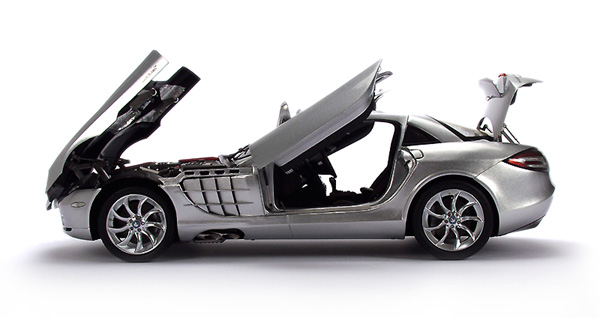
SLR Mclaren - mercedes-benz photo

Sunday, August 30, 2009

1949 Mercedes-Benz 170S Cabriolet A

Born out of still-warm ashes
The small Cabriolet A series of the 170S line-up was presented for the first time in May 1949 at the Hanover Technical Export Fair. Largely based on the W136 series, its development was rather quick and successful. The facilities and equipment weren’t damaged by Allied bombing on German soil during the war, which made its development easier. Because of this, Mercedes-Benz was able to quickly launch production of its mid-size cars after the war.


Rebuilding a name
Sadly, after years of prosperity where the German aristocracy proudly travelled around in luxurious 770Ks and other prestigious convertibles, Mercedes was forced to temporarily abandon its ultra-elitist cars and content itself with building more popular, but always comfortable, vehicles.

Taking up where they left off
Despite the failure of the 1938 230 Series, the production of which never exceeded 4,210 units, the W136 platform was nonetheless used for the post-war revival of the brand with the 170.

While the 230 Series used a 2.3-litre inline six delivering 55 hp, the post-war economic conditions in Germany forced Stuttgart to cut down to four cylinders. The 1.8-litre S-4 would only produce 52 hp and 83 ft-lb of torque.

However, the frames would from then on feature double crossbeams with coils springs and a sway bar. This innovation was the invention of Rudolf Uhlenhaut, who would later become much more famous with his interpretation of a certain 300SLR in 1955.

Luxury confirmed
The creation of the 170S following the 170V (sedan) demonstrates a firm willingness to return to assertive luxury. Mercedes’ mythical letter S was always synonymous with prestige. The 170S’ sales price would almost double that of the sedan. It would be available with a choice of two or four seats, but would be out of the average German’s league. Only 830 units were built over the two-passenger Model A’s three-year life span and only 39 of those would be sold in 1949.